Key Takeaways
-
Most teens start comprehensive braces after most permanent teeth erupt, often ages 11 to 16, but a check-up at age 7 does not mean immediate treatment; timing depends on the teen's bite and jaw growth.
-
Fixed braces treat a broad range of crowding, gaps, overbites, underbites, and crossbites without relying on the teen to remember wear, while clear aligners are removable but only work when worn consistently.
-
Ask for a written treatment plan and fee, since local estimates run roughly $3,000 to $7,500 and treatment commonly takes 18 to 24 months depending on case complexity and cooperation.
-
Plan for retainers after active treatment, since teeth tend to drift back, and reinforce daily brushing, flossing, and avoiding hard, sticky, or chewy foods to protect results.
If your teen’s smile has you wondering about next steps, you’re in good company. Plenty of Bradenton parents hit this exact moment, usually after a school picture, a dentist comment, or a teen who suddenly stops smiling with teeth. The good news? Today’s options for braces for teens Bradenton families can choose from are more comfortable, more flexible, and honestly more fun than what you or I had at that age.
The not-so-great news is that the choices can feel overwhelming. Metal, ceramic, clear aligners, timing, cost, insurance… where do you even start? That’s why we put together this friendly guide. Think of it as a chat over coffee with someone who has been through it.
Below, you’ll find eight facts that help you feel confident about your teen’s orthodontic journey in 2026. We’ll cover timing, treatment types, costs, daily care, and what to ask at that first visit. Let’s get your teen smiling again!

1. The Right Time for Teen Braces Is Individual
Parents often ask, “When should a teenager get braces?” The honest answer is that it depends on your teen. Many teens begin comprehensive treatment after most of their permanent teeth have come in, often during the early-to-mid teen years. A Bradenton-area practice reports that its most common teen start range is 11 to 16, though that is one practice’s experience, not a rule.
You may have heard that kids should see an orthodontist by age 7. That is true, and it comes from the American Association of Orthodontists. But here’s the part many parents miss: a check-up at 7 does not mean braces at 7. Many children are simply monitored until the timing is right.
Timing depends on a few things:
- How many permanent teeth have erupted
- The teen’s bite and jaw growth
- The specific alignment issue being treated
- Your teen’s readiness to follow care instructions
If you’re not sure where your teen falls, our simple guide on what age to get braces walks through it in plain language.
2. Teens Have More Brace Choices Than Ever
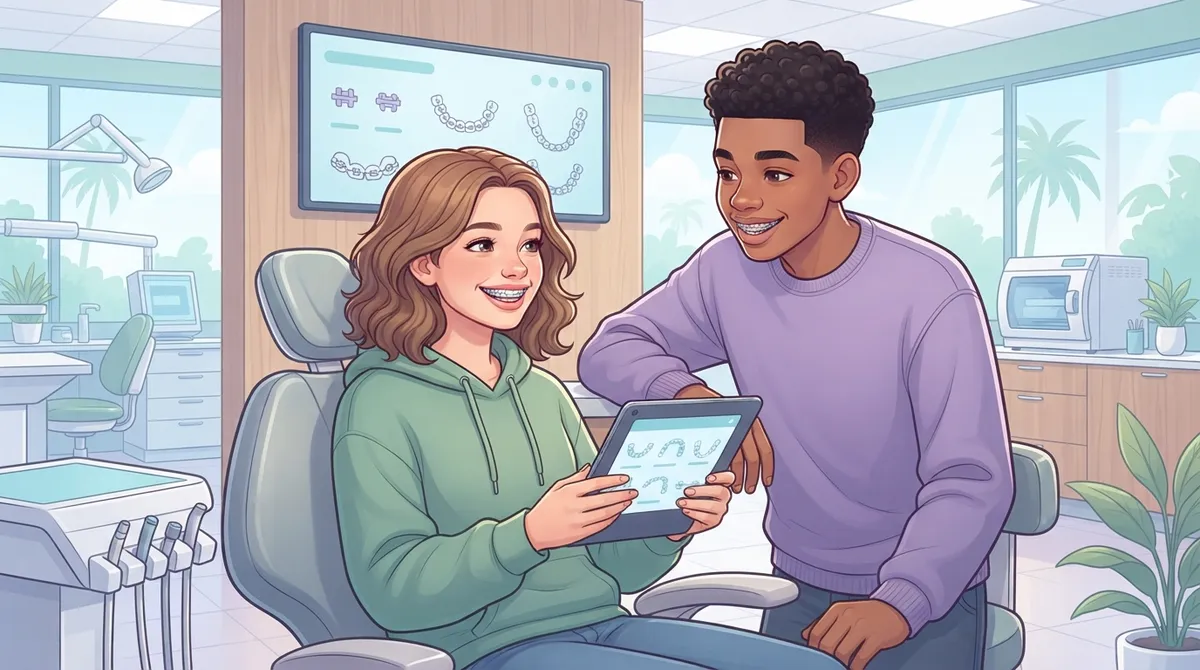
Gone are the days of one-size-fits-all braces. Bradenton-area practices commonly offer traditional metal braces, tooth-colored ceramic braces, clear aligners, and, in some offices, lingual braces. The best fit depends on your teen’s bite, alignment needs, and personality.
| Option | Visibility | Removable? | Good For |
|---|---|---|---|
| Metal braces | Most visible | No | Wide range of alignment and bite issues |
| Ceramic braces | Less noticeable | No | Teens wanting a subtler look |
| Clear aligners | Barely visible | Yes | Responsible teens with suitable cases |
| Lingual braces | Hidden behind teeth | No | Select cases at select practices |
Curious how the main types stack up? Take a peek at our overview of types of braces to see which ones catch your teen’s eye.
3. Fixed Braces Treat a Broad Range of Problems
Here’s something worth knowing: fixed braces can treat a very wide range of alignment and bite problems. Crowding, gaps, overbites, underbites, and crossbites are all on the table. Because the brackets stay put, there’s no worry about a teen forgetting to wear them.
For many parents, that built-in consistency is the big selling point. Your teen has enough to remember already, between homework, practice, and friends. Fixed braces work around the clock without a reminder from you.
If your teen has a complicated bite, fixed braces are often the starting point of the conversation. An orthodontist will confirm what works best after an exam, so it’s always smart to get a personalized recommendation rather than guess.
4. Clear Aligners Can Work Beautifully, With a Catch
Clear aligners are a hit with teens who care about how braces look in photos. They’re removable, less noticeable, and easier to take out for eating and brushing. Many teens love that freedom.
The catch? They only work when they’re worn. Aligners require consistent wear, and they may not be right for every case. A teen who tends to leave things in a backpack may do better with fixed braces. A teen who’s organized and motivated may thrive with aligners.
At Segovia Orthodontics, we offer clear aligners alongside traditional options, so we can help you weigh the pros and cons honestly. We also offer Angel Aligners, which use a “7+3” wear schedule and a frosted finish designed to minimize shine and visibility.
5. Some Braces Are Actually Fun for Teens
Let’s be real: a teen who likes their braces is a teen who takes care of them. That’s why personality matters. Options like WildSmiles brackets come in fun shapes such as stars, hearts, and flowers, and they can help kids and teens feel excited instead of embarrassed.
There’s a practical perk too. The unique bracket shape is designed to keep plaque from collecting right on the tooth surface, and the visible bracket shape gives teens an easy way to see whether they brushed well. If the shapes look clean and clear, nice job!
Want to see what’s available? Explore WildSmiles braces and see if your teen’s personality fits. For teens who prefer a more custom, discreet look, LightForce orthodontics uses 3D-printed, custom-fitted brackets in clear or white options, and the digital planning can streamline treatment.
6. Knowing the Process Takes the Stress Out
A lot of parent worry comes from the unknown. Here’s the typical journey for most teens, step by step:
- Examination and diagnosis: The orthodontist looks at teeth, bite, and jaw development.
- Personalized treatment plan: You review recommended options, timeline, and fees.
- Placement: Braces or the first set of aligners are put in place.
- Progress visits: Regular check-ups keep treatment on track.
- Retainer phase: After active treatment, retainers help keep that new smile in place.
That last step matters more than most families expect. Teeth like to drift back, so retention is part of the plan, not an afterthought. You can learn more about orthodontic retainers before treatment even begins.
7. Cost and Time Vary, So Get It in Writing
Let’s talk numbers, because every parent wants to. One local Bradenton-area article estimates teen orthodontic treatment at roughly $3,000 to $7,500, depending on the appliance and the complexity of the case. Treat that as a ballpark, since fees and what’s included differ from office to office.
As for time, local practice materials commonly describe comprehensive treatment as about 18 to 24 months. Your teen’s actual timeline depends on case complexity and how well they follow instructions. Only the treating orthodontist can give you a real estimate.
| Factor | What It Affects |
|---|---|
| Case complexity | Total fee and treatment length |
| Type of appliance | Fee and visit schedule |
| Teen cooperation | How smoothly treatment moves |
| Insurance benefits | Out-of-pocket amount |
The smartest move is to ask for a written treatment plan and fee from any office you consider. Also ask about payment options. Our page on orthodontic financing explains flexible ways families spread out the cost, and you can read how dental benefits may help in does your orthodontist accept dental insurance.
8. Daily Care Makes or Breaks the Result
Here’s where teens and parents become a team. Great results come from great habits, and that means brushing, flossing, and watching what goes in the mouth. Here are a few tips to share with your teen:
- Brush after meals and before bed, paying extra attention around brackets
- Floss daily, using floss threaders or water flossers if needed
- Skip hard, sticky, and chewy foods that can break brackets
- Wear a mouthguard for sports
- Keep every scheduled appointment
Not sure which foods to skip? Check out 13 foods to avoid with braces and stick it on the fridge. And if a wire pokes or a bracket pops loose, don’t panic. Our orthodontic emergency page explains what to do and when to call.
What to Ask at Your Teen’s First Consultation
Walking into a consultation with good questions makes you feel like a pro. When you compare Bradenton-area providers, consider asking about:
- The orthodontist’s credentials and specialty training
- The recommended treatment and any alternatives
- The total fee and exactly what it includes
- Insurance benefits and payment plans
- How often appointments happen
- Emergency support and what retention costs
Credentials matter here. Dr. Flor Segovia is a board certified orthodontist, and you can learn about the certification itself through the American Board of Orthodontics. It’s a good thing to look for with any provider.
You can also see what to expect on day one in our guide to your first orthodontic visit, or dig deeper into teen orthodontic treatment at our practice.
Why Local, Family-Friendly Care Matters
Teen orthodontics isn’t just about teeth. It’s about a teen who feels comfortable walking into the office, a parent who feels heard, and a schedule that works around school and activities. A supportive, relaxed environment makes treatment easier for everyone.
At Segovia Orthodontics at Lakewood Ranch, we provide personalized care for kids, teens, and adults, with bilingual service in English and Spanish. Curious how other families feel? You can visit us on Google and see what Segovia Orthodontics patients say, or follow along with our Instagram page and our Facebook page for a peek at the fun side of treatment.
Ready to Help Your Teen Smile Bigger?
Choosing braces for your teen doesn’t have to feel heavy. Start with an exam, ask your questions, compare written plans, and pick the option that fits your teen’s life. A confident smile is worth the effort, and your teen will thank you later (maybe not at 14, but eventually!).
Ready for the next step? Request an appointment today, or call us at 941-557-1333 and our friendly team will help you get started.
FAQs
Q: When should a teenager get braces?
A: Many teens start comprehensive treatment after most permanent teeth have come in, often in the early-to-mid teen years. The right timing depends on your teen’s bite, jaw growth, and diagnosis, so an orthodontic exam is the best way to know for sure.
Q: How much do braces for teens cost in Bradenton, Florida?
A: One local Bradenton-area estimate puts teen treatment at roughly $3,000 to $7,500, depending on the appliance and case complexity. Fees and inclusions vary, so ask for a written quote and ask about payment plans and insurance benefits.
Q: Are clear aligners or traditional braces better for my teen?
A: It depends on your teen’s needs! Fixed braces treat a broad range of problems and work all day, while clear aligners are removable and less noticeable but need consistent wear. Your orthodontist can recommend the best fit after an exam.
Q: How long do teens usually wear braces?
A: Local practice materials commonly describe comprehensive treatment as about 18 to 24 months. Your teen’s timeline can be shorter or longer depending on case complexity and how well they follow care instructions.
Q: What types of braces are available for teens in Bradenton?
A: Bradenton-area practices commonly offer traditional metal braces, ceramic braces, and clear aligners, and some offer lingual braces. At Segovia Orthodontics, teens can explore options like WildSmiles braces, LightForce braces, and Angel Aligners.
Our Service Area