Key Takeaways
-
There is no universal replacement date for retainers; replace or repair them based on condition, fit, and damage rather than the calendar.
-
Clear plastic retainers wear out most often, so replace them when they crack, warp, develop thin spots, or no longer fit snugly.
-
Stop wearing a cracked, warped, or sharp-edged retainer and contact your orthodontist instead of attempting a DIY glue or wire fix.
-
If a retainer is lost or broken, call your orthodontist right away, since teeth can shift quickly, especially soon after braces or aligners.
-
Retainers are usually needed long term, often for life, even though the wearing schedule may change over time as directed by your orthodontist.
-
Protect your retainer by always storing it in its case, keeping it away from heat, cleaning it gently, and removing it when eating.
You finished braces or aligners, and your smile looks amazing. Now comes the question almost every patient asks sooner or later: how often should retainers be replaced? Maybe your clear retainer looks cloudy. Maybe your Hawley wire feels a little bent. Or maybe your retainer just feels odd when you put it in.
Here is the honest answer: there is no one-size-fits-all calendar date. Most retainers do not come with an expiration date. Instead, they need to be replaced or repaired when they are damaged, no longer fit well, or stop doing their job. That is a big relief for some people and a bit of a puzzle for others!
In this friendly guide, we will walk through how long each type of retainer usually lasts, the warning signs to watch for, what to do if yours is lost or broken, and why wearing your retainer for the long haul matters so much. Whether you are a parent helping a teen stay on track, a busy professional, or an adult protecting a second round of treatment, you will find clear answers here.
Is There a Set Schedule for Replacing Retainers?
The short answer is no. The American Association of Orthodontists says retainers can last many years with proper care, but they may eventually need replacement. The group does not give a universal replacement interval.
Why? Because every mouth, habit, and retainer is different. Someone who clenches or grinds at night may wear through a clear retainer faster. Someone who keeps their retainer in its case and cleans it gently may get many more years out of the same one.
One 2023 survey of orthodontists found that 44.1% expected clear plastic retainers to last up to one year, while 3.9% thought they could last a lifetime. Keep in mind that these numbers show what clinicians expect, not a guaranteed lifespan or a clinical standard. Your own retainer may last a shorter or longer time.
So instead of watching the calendar, watch your retainer. Its condition and fit tell you far more than its age does.
How Long Does Each Type of Retainer Last?
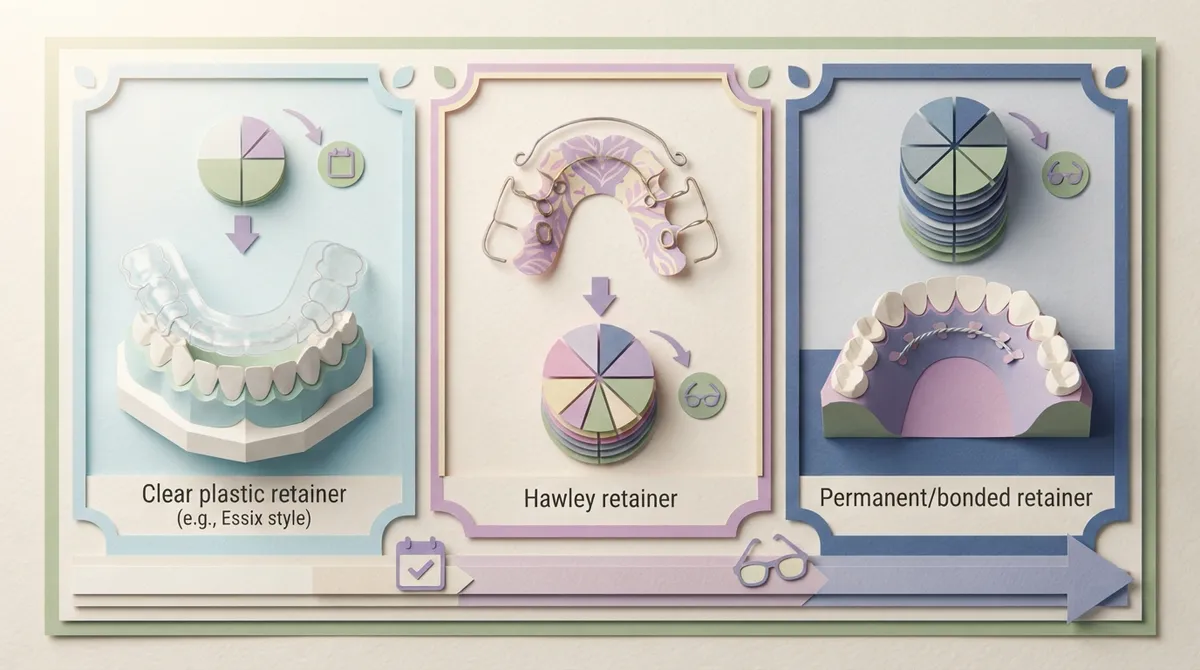
The type of retainer you wear plays a big role in how long it holds up. Here is a quick comparison to help you see the differences at a glance.
| Retainer Type | What It Is | Common Wear Issues | When to Replace or Repair |
|---|---|---|---|
| Clear removable (plastic) | Thin, see-through tray that fits over your teeth | Cracks, cloudiness, warping, thin spots from grinding | When it cracks, warps, wears through, or no longer fits snugly |
| Hawley (acrylic and wire) | Acrylic plate with a metal wire across the front teeth | Bent wire, cracked acrylic, loose fit | May be adjusted or repaired; replace if the damage is major or the fit is poor |
| Fixed (bonded) | Thin wire glued behind the teeth | Loose bond, broken or bent wire | No routine date; check regularly and seek care if it detaches or breaks |
Each type has its own personality, so let us look at them one by one.
Clear Plastic Retainers
Clear removable retainers are popular because they are discreet and comfortable. They are also the type most likely to wear out. Over time, they can crack, develop thin spots, or warp, especially if they get hot. Leaving one in a hot car, near a dishwasher, or in hot water can change its shape.
A warped or damaged clear retainer may not hold your teeth where they should be. It can also irritate your gums and cheeks. If you are curious about how these work, our guide on what a clear retainer is and why you need one covers the basics.
Hawley Retainers
A Hawley retainer is made of acrylic with a wire that wraps across the front teeth. These tend to be sturdy, and the best part is that they can often be adjusted or repaired. A bent wire or a small crack does not always mean you need a brand-new one.
Still, a Hawley that is cracked, poorly fitting, or has a damaged wire should be checked by your orthodontist. Learn more in our post with 12 Hawley retainer facts every patient should know.
Fixed (Bonded) Retainers
A fixed retainer is a thin wire bonded to the back of your teeth. There is no routine replacement date for these. However, the wire or the glue can loosen or break over time. Because you cannot take it out, it is smart to have it checked at regular visits. If you want to dig deeper, read these 14 fixed retainer facts every orthodontic patient should know.
Signs It Is Time to Replace Your Retainer
Your retainer will usually tell you when something is wrong. Here are the most common signs that it is time to call your orthodontist:
- Cracks or holes: Even tiny cracks can grow and weaken the retainer.
- Warping: A retainer that has changed shape may not hold your teeth correctly.
- Sharp or rough edges: These can scratch your tongue, lips, or cheeks.
- Poor fit: It will not seat all the way, or it feels unusually loose.
- Ongoing discomfort: Pain that does not settle down is a signal to get it checked.
- A loose or broken wire: This applies to both bonded retainers and Hawley wires.
If you notice any of these, reach out for an assessment instead of guessing. A quick visit can save you from bigger problems later.
Why a Tight Retainer Is Not Always a Good Sign
Sometimes a retainer feels snug after you skip a few nights. That can mean your teeth have started to shift. The tightness is your teeth pushing back against the retainer. This is a reminder to wear it as prescribed, and to let your orthodontist know if it feels painfully tight.
Can You Keep Wearing a Cracked or Warped Retainer?
It is tempting to keep using a retainer that is a little cracked. After all, it still seems to work. But a damaged retainer may not hold your teeth as intended, and it can irritate your mouth.
Here is what to do and what to avoid:
- Stop wearing the retainer if it is cracked, warped, or has sharp edges.
- Do not force a painful or ill-fitting retainer into your mouth.
- Do not try to fix it yourself with glue or by bending the wire.
- Keep the retainer safe in its case and bring it to your orthodontist.
- Call the office promptly so the team can advise you on the next step.
Do-it-yourself repairs can make things worse. A small bend in the wrong direction can move your teeth in the wrong way.
Replacing a Retainer Is Not the Same as Wearing It
Here is something many people mix up. How often you replace a retainer is a separate question from how long you wear it. The American Association of Orthodontists says retainers are typically needed long term, often for life. The schedule of wear may change over time. For example, you may go from every night to a few nights a week. Always follow your own orthodontist’s instructions.
A 2025 review of orthodontic retainers also recommends lifelong retention. The authors describe follow-up checks about every four months in the first year and then once a year from the second year onward. That is the reviewers’ recommendation, not a universal rule, but it shows how much ongoing care matters.
Why so much focus on keeping retainers? Because teeth naturally want to move. Without retention, they can drift back toward their old spots. To learn more about how this works, see our post on why teeth shift back after braces come off.
What to Do If Your Retainer Is Lost or Broken
Lost a retainer? Take a deep breath. It happens to almost everyone at some point. Retainers wrapped in napkins at restaurants are the stuff of legend! The key is to act quickly.
Here is a simple plan:
- Look around first. Check pockets, bags, the car, and anywhere you ate recently.
- Call your orthodontist right away. The sooner you call, especially soon after treatment, the less time your teeth have to move.
- Skip the do-it-yourself fix. Do not try to wear an old retainer that no longer fits.
- Book a visit. Your orthodontist can check your teeth and make a new retainer.
If your teeth have already moved, a new retainer alone may not bring them back to where they were. In that case, your orthodontist may suggest corrective treatment first, then a fresh retainer. For more details, read our guide on lost retainer replacement and what to do right away.
Tips to Help Your Retainer Last Longer
You cannot control everything, but a few simple habits can add months or even years to your retainer’s life.
- Always use the case. Never wrap it in a napkin or tuck it in a pocket.
- Keep it away from heat. Avoid hot water, dashboards, and hot dishwashers.
- Clean it gently. Use a soft toothbrush and cool or lukewarm water with mild soap.
- Remove it when eating. This protects it from bites and stains.
- Keep it away from pets. Dogs love to chew retainers more than you might think.
- Bring it to checkups. Your orthodontist can spot early wear.
For more care ideas, check out our tips on how to master retainer care and protect your smile. You can also avoid common slip-ups with our post on orthodontic retainer mistakes to avoid.
Retainer Replacement for Different Patients
Every patient has a different life, so replacement needs can look a little different too.
For Parents of Kids and Teens
Kids and teens are busy, and retainers get lost or left behind a lot. Keep a spare case in the backpack and one at home. Encourage your child to tell you right away if a retainer breaks or goes missing, so you can call us quickly. A short delay can matter in the months right after braces.
For Busy Professionals and Adults
If you travel or work long hours, your retainer routine can slip. Set a phone reminder, and keep a case in your bag or desk. Adults who had treatment years ago and noticed their teeth moving can still get help. Our adult orthodontics options may be a good fit if relapse has crept in.
For Big-Event Planners
Getting ready for a wedding, graduation, or big career moment? Make sure your retainer fits well before the event. A snug, healthy retainer helps protect the smile you worked so hard to earn.
Why Choose Your Orthodontist for Retainer Care
Retainers are not just plastic and wire. They are custom tools that protect your investment. An orthodontist can check the fit, adjust a Hawley, test a bonded wire, and make a new retainer using precise measurements.
At Segovia Orthodontics, Dr. Flor Segovia and our team offer bilingual care in English and Spanish, and we focus on a comfortable, family-friendly experience. We provide custom orthodontic retainers to help keep your results in place after braces or aligners. You can also learn more about our board-certified care on our board-certified orthodontist page, and you can read about the standards of the American Board of Orthodontics.
Wondering what a replacement might cost? Our guide on understanding clear retainer costs before you pay can help you plan. Want to see what other patients think? Visit us on Google — Segovia Orthodontics, and follow along with smile stories on our Instagram page.
Final Thoughts: Replace by Condition, Not by Calendar
So, back to our big question: how often should retainers be replaced? There is no fixed timeline. Replace or repair your retainer when it is damaged, lost, uncomfortable, or no longer fits right. Keep wearing it as your orthodontist prescribes, because retention is usually a long-term, often lifelong, habit.
If your retainer is cracked, warped, loose, or missing, do not wait and hope your teeth stay put. A quick visit now can protect the smile you worked hard for. If you need help, request an appointment with our team, or call us at 941-557-1333 and we will gladly take a look.
FAQs
Q: How often should clear plastic retainers be replaced?
A: There is no set schedule. Clear retainers can crack, wear thin, or warp, so replace one when it is damaged or no longer fits snugly. In one 2023 survey, 44.1% of orthodontists expected them to last up to a year, but your own habits and care make a big difference.
Q: Do permanent or bonded retainers need to be replaced?
A: Bonded retainers do not have a routine replacement date. The wire or glue can loosen or break, though, so have it checked at regular visits. If a section comes loose or the wire is damaged, call your orthodontist promptly.
Q: Can I keep wearing a cracked or warped retainer?
A: It is best not to. A cracked or warped retainer may not hold your teeth in place and can irritate your mouth. Stop wearing it, keep it in its case, and contact your orthodontist rather than trying a do-it-yourself fix.
Q: How soon should I replace a lost retainer after braces?
A: As soon as possible. Teeth can shift quickly without retention, especially soon after treatment. Call your orthodontist right away so they can check your teeth and make a new retainer before bigger movement happens.
Q: Do I need to wear a retainer for life after orthodontic treatment?
A: Long-term wear, often for life, is commonly recommended to help keep your teeth aligned. The American Association of Orthodontists notes the schedule may change over time, such as fewer nights per week. Always follow your own orthodontist’s instructions.
Our Service Area